A man takes a photo of himself. He takes a cheap analog camera, turns it around to point the lens at him, and looks straight at it. He clicks the shutter and pays no mind to the flash though it blinds him temporarily. He hands the camera to his companion with a simple missive of, “Bigyan mo ako ng kopya ‘nyan. Akin yan.”
What’s so unusual about that man and his picture? What makes him different from countless others (including many of us) who like taking pictures of themselves—aside from the fact that he uses an outdated analog camera in the age of DSLRs? What makes him special?
That man was a Dumagat and that was the first time he held a camera and ever took a photograph.
***
Our group’s thesis for senior year was the use of participatory photography to empower members of the Dumagat tribe to represent themselves. Gone are the days when the participants were just passive research subjects. This time, we let them take control of the medium.
We let them use pictures—things that are really of no necessary consequence to us normally—to let them tell their stories. That notion might be of general acceptance to us who are used to the idea of letting our stories flow visually through pictures. Sure, the Dumagats know about photographs. Usually, they’ve been on the receiving end of a zooming lens. For the Dumagats in Antipolo, this was their first time to be behind the cameras—to be the storytellers instead of the subjects.
They were liberated. When before we would ask them what made them proud of being Dumagat, they would be unable to answer. Now, they could go on and on about what made them distinctly Dumagat.
They are one of the numerous ethnic minorities in the Philippines. Though mainly from Nueva Ecija, ago a group broke off and settled in the mountains of Antipolo. To get there from Ateneo, we had to take a three-hour drive to Barangay Calawis in Mt. Purro, up in the mountains to Camp Explore, owned by Alberto Malvar or Sir Toto as we called him. Sir Toto has worked with the Dumagats for more than 20 years. He literally financed the building of the road to Calawis.
In Camp Explore, we would sit with the Dumagats and watch action films, projected on a white cloth hung over a wall. Some days it would be a Fernando Poe, Jr. starrer (their favorite). Once it was a Manny Pacquiao fight. They would whoop with glee whenever Pacquiao or Poe got a punch in. Afterwards, we’d lay out the new batch of pictures we developed, and they’d pick out which ones they took, or which ones were taken by members of their family. They’d start to tell us stories. Nanay Nene asked her granddaughter to take a picture of her surrounded by floodwater, unable to cross the hanging bridge to go home. Ka Cando would proudly point us the pictures his son took. Ka Lito would show us the pictures he took of them burning down trees for charcoal—never mind that it was illegal. He deemed it worthy because it showed us what their life was.
For so long, they have always been the “others” in our research. Now, they are showing us that for them, we were the “others”. We didn’t have to represent them. They themselves could show us who they were and what they wanted us to see.
We did this every weekend for five months straight. On good days, the roads were dry, visibility was okay, and we had a car. On bad days, the rain was pouring torrentially, visibility was near zero, and we had to take a jeeps and tricycles up a really remote location—so remote that our cellphones lost signals less than halfway through the drive.
But then they’d always be there, waiting for us, excited to see the pictures they took. They’d tell us of friends who’d never used a camera before and asked to use one. They’d show us how they used to dress before. The teenage boys would show us their trips to falls and rivers. Funnily enough, they were always able to capture that suspension in air perfectly—that one we would waste a lot of camera memory on just to get perfectly—in one single shot.
For the first time, it was about them and they were doing the telling. And they knew we would be able to understand them because they had the pictures to show us what they had a hard time just describing before.
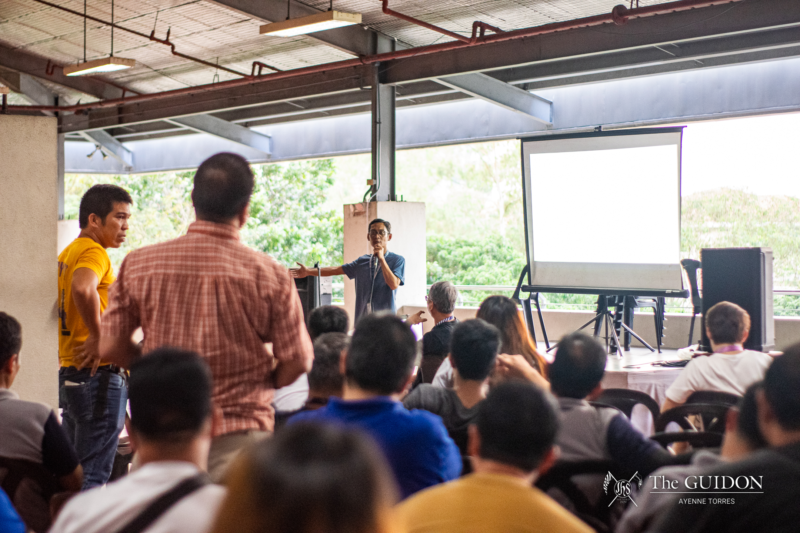
They were able to tell their stories all the way to Singapore to a room full of Communication scholars. Our group—Rishi Mandhyan, Joshua Pangilinan, and I together with our thesis adviser Jonathan Ong, were able to bring their pictures. We showed those scholars what the Dumagats wanted to show them, not what pictures we picked but the stories they chose themselves to tell.
As someone who worked with them throughout those months, I felt proud for our group, but more so for them. Finally, they got their stories that they wanted us to know heard. And it tickled our group pink to present before the very people we quoted and used as sources in our thesis.
There we saw just how powerful photographs can be—a medium we did not want to use at first. It was an idea suggested by our adviser that we hastily rejected in the beginning because we wanted to make videos for the Dumagats. We were communication majors and we wanted to do something for them. After a few weeks and the day before submitting our thesis proposal, we realized we were asking the wrong question.
It was never about what could do for them—it was about what we can do with them.
And the photographs they took indeed spoke a thousand words on their behalf, even a million. Because in that room, at the International Communication Association Conference in Singapore, a room-full of Communication scholars and leaders were able to understand the motivation behind Nanay Nene asking her granddaughter to take a picture of her, so that “kahit mawala na ako, maalala pa rin ako.”
Really, no words were needed.
Carmina Reyes (AB Comm ’10), along with groupmates, Rishi Mandhyan (AB Comm ’10) and Joshua Pangilinan (AB Comm ’10) and adviser Jonathan Ong presented their study at the International Communication Association Conference in Singapore last June 21-26. Their work won Top Paper 2nd Prize at the event. The study was also awarded the Best Project Thesis by the Communication Department last year.