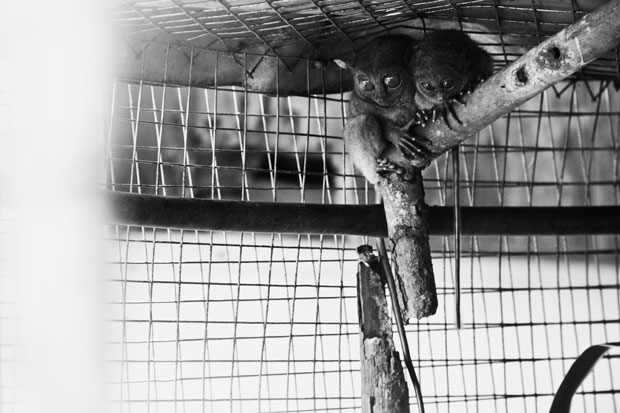
Endemic treasures. The ACL will give students an opportunity to apply what they learned inside the classroom on the field. Photo by Ean L. Dacay
TO PROMOTE the study and appreciation of Philippine culture and heritage, the Sociology and Anthropology Department launched this year’s Ateneo Cultural Laboratory (ACL) last December 12 in Leong Hall, as part of the cultural heritage program of the department.
Since 2009, the department has been sending students to various areas of the Philippines for study and research. This year’s ACL is a three-week program set in Bohol from April 17 to May 9, 2012.
During the opening ceremonies of the program’s launch, University President Fr. Jose Ramon Villarin, SJ, expressed hope that through the ACL, students would “discover how beautiful we [Filipinos] are in our diversity.”
Department Chairperson Emma Porio said that the program was the department’s way to inculcate in their students a “commitment to know our culture.”
“I always tell my students [that] you cannot be proud of something you do not know,” she said. “I hope [that] through this program, we’ll feel connected to who we are.”
Heritage as an asset
Cultural Heritage Program Director Fernando Zialcita said that the opportunity to apply textbook information in practice is what makes the program appealing.
“It’s more exciting for students to learn in the field… they see the applications [of what they have learned],” he said. He added that the study of heritage used to be taken for granted because it was not something that could “feed a person” or create jobs.
However, he cited the boom of local tourism and the salability of local products as examples of how cultural heritage can serve as livelihoods.
Institute of Philippine Culture (IPC) Director Czarina Saloma-Akpedonu said that the program aimed to “enhance the transformative potential of knowledge generation.” She added that to help local communities appreciate their own cultures, giving back the knowledge gained from these communities is important.
Culture, history and art
The three-week program includes various activities to help the participants learn more about the culture in Bohol. There will be tours to the four towns of Albuquerque, Baclayon, Loay and Loboc, in order to showcase Bohol’s cultural landscapes, buildings and structures, arts and crafts, cuisine and history.
While the ACL is a project of the Sociology and Anthropology Department, it has partnered up with the History Department and the Fine Arts Program after a previous trip to Intramuros last 2010.
“You can’t talk about cultural heritage separate [from] history and art,” Saloma-Akpedonu said. “[We saw] the clear need to involve the [History and Fine Arts departments].”
The university itself has also tied up with partner schools in Bohol, such as the Holy Name University, Philippine Christian University and the University of Bohol, for the lectures that will be given to ACL participants.
Local government units and non-government organizations, particularly the Center for Culture and Arts Development of the Province of Bohol and the Bohol Tourism Office, are also partners in the program.
Reaching deeper and wider
In line with the goal of using knowledge to create change, ACL aims to contribute to the community in Bohol through the yields of the participants’ studies. These include the documentation of landscapes, structures, cuisine, crafts, and oral histories, packaging and marketing plans for local products, and the creation of tour scripts promoting the four towns.
The participants, in cooperation with faculty members, will also develop teaching modules to help araling panlipunan instructors to teach about pride of place and local heritage.
At the end of the program, the participants’ findings will be reported back to the community and the local government. Publications and online resources will also be made available.
Requirements for interested students
The program is open to all interested students, professionals and the general public. Zialcita said that the program has drawn participants from various backgrounds.
“We get students from all over. I think it’s better, [because] I believe in an interdisciplinary approach,” he said.
Only thirty students can be accommodated in the program, with priority slots given to social science majors as well as to students taking a minor in cultural heritage. The program can be credited for six academic units, and participants will be given a certificate of course completion in cultural heritage documentation.
The deadline for sign-ups is on February 17, 2012 at the Sociology and Anthropology Department.