 UPDATE: Statement of Clarification on “Integrity in UAAP”
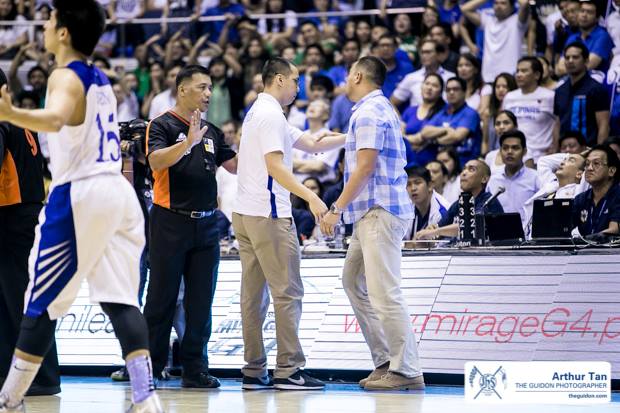
Social media has been abuzz over the bad officiating of the referees during the last Ateneo-La Salle game. Several dubious calls and obvious non-calls were questioned online. There were comments about the game being rigged and the referees being bought. After this heart-breaking loss, is it proper to say that this is just a game and it is time to move on?
Important to the resolution of every disagreement is an attempt to recognize what went wrong so that steps can be taken to resolve the issue, to take to task those who may have done wrong and to avoid future incidences that will lead to the same problem.
I have been watching since Season 68 and I have seen so many dubious calls, obvious non-calls and controversial calls that have been done by the referees against the Blue Eagles (But it is important to note that faulty officiating does not only occur against the Ateneo). The athletes continue to fight on, continue to play ball and continue to try their best to win. But given this spate of bad officiating, what has the University Athletic Association of the Philippines (UAAP) done to improve the system? But that question leads to an even more important question: What is the role of the Ateneo’s continued participation in the UAAP given its mission vision?
Let me quote the university’s mission vision: “As a University, the Ateneo de Manila seeks to preserve, extend, and communicate truth, and apply it to human development.” In the same statement, the university also aims to promote justice.
Is the university’s continued participation in the UAAP in line with its mission vision? If so, how can the university defend itself by participating in a league that allows faulty officiating to continue and even to prevail, without attempting to rectify its ill effects? How can the university defend itself by participating in a league that enforces a two-year residency rule that is prejudicial to athletes who transfer to other schools? How can the Ateneo be a witness to truth when it allows these injustices to continue right under its very eyes?
Although the Ateneo representative voted against this two-year residency rule, the majority of the members of the UAAP board voted to uphold it. Can the Ateneo just say that it was a majority decision, knowing well that this two-year residency rule runs counter to its values?
In the same way, wrong calls and missed calls are part of every game, as referees are human beings who also make mistakes. But can the Ateneo just dismiss this regular occurrence as part of the game? Can rules be introduced allowing for the review of certain calls upon a coach’s request right in the game? Can a numerical standard be defined such that if the number of wrong and missed calls exceeds this standard, then a game is qualified for replay?
As a university, it is the duty of the Ateneo’s administration and faculty to reflect also on these questions, since these issues affect its very own students. Behind every athlete is a student who not only has to train early in the morning and cut some classes during tournaments, but who also has to write papers, study for examinations, prepare for group reports and do research. An athlete is a student, and a hard-working student, who tries his or her best to balance the demands of the Ateneo education, the Ateneo sports program and his or her own social life.
Faculty members, in the spirit of cura personalis, are called to support these student-athletes, from watching and cheering them in the gallery, to being mindful of their needs and perhaps extending and enforcing consultation hours to allow the athletes to catch up. But more than this, the faculty, as an institution, should support the athletes in ways that only faculty can do, such as engaging in lively discussion and research on issues hounding the athletes. Such issues include the ethics of the two-year residency rule, statistical improbabilities of certain occurrences in the game (like no fouls being called after a certain time which can be modeled by a Poisson Distribution), the ethics of refereeing and making consistent calls and on the definition of numerical standards that can be used to define a “poorly-officiated” game. Faculty support to student athletes can make a difference, from boosting the morale of the athlete to showing the community that the faculty cares for its students, in the spirit of cura personalis.
Although the faculty has been very active in discussing issues of national significance such as the PDAF scam and the RH Law, its record for standing up for the university’s athletes cannot compare. I believe that as faculty members, it is our responsibility to care for the students right in our midst and to speak out against the injustices that may affect them. Let us not fail to care for our student-athletes who have chosen to enroll in our school and represent it in their chosen sport. Their victories, earned through hard work and training, bring honor to the Ateneo de Manila, which we are all a part of.
After raising all these questions, let us go back to the original reason on why the Ateneo bolted from the NCAA and joined the UAAP. If I remember correctly, one of the reasons we left was the violence in the games. Right now, the games are not as physically violent, but it is emotional violence that is affecting the athletes. A bad call demoralizes an athlete, but an athlete has to move on despite of that. On the other hand, several bad calls in the same game become an emotional assault on the entire team.
The Ateneo-La Salle game is a game where our athletes have invested so much of their time and effort. Moving on from a loss like that can only happen if lessons are learned and if the university defends its athletes and the truth (in line with its mission vision). Only when this happens can we say, “If I should win, let it be by the code, with my faith and my honor held high. If I should lose, let me stand by the road, and cheer as the winners go by.”
Go Ateneo! One Big Fight!
Lester Yee is a lecturer from the Department of Interdisciplinary Studies.
UPDATED: 7:20 PM, September 9, 2013